
Foreign direct investment (FDI) inflows into India have crossed the $1 trillion milestone in the April 2000-September 2024 period, firmly establishing the country's reputation as a safe and key investment destination globally. According to data from the Department for Promotion of Industry and Internal Trade (DPIIT), the cumulative amount of FDI, including equity, reinvested earnings and other capital, stood at $1,033.40 billion during the said period.

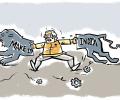
The Modi government's flagship initiative 'Make in India' launched 10 years ago has helped the country boost exports, push investments and promote manufacturing. Under the initiative, launched on September 25, 2014, a series of measures have been taken by the government to boost local manufacturing. These initiatives include the rollout of production linked incentive (PLI) schemes for 14 sectors, easing foreign direct investment (FDI) norms, reducing compliance burden to improve business climate, all approvals through single window, and rolling out of the national logistics policy.

The rising dependence on discounted crude oil has resulted in India's trade deficit with Russia hitting the second-highest place last year, after China, reveals Department of Commerce data. From April through January 2022-23 (FY23), India's maximum trade deficit was with China, at $71.58 billion. This was followed by Russia, where the deficit expanded sevenfold - from $4.86 billion in April-January of 2021-22 (FY22) to $34.79 billion during the same period in FY23.

Net inflows were $18.4 billion for the rolling 12-month period ended January 2024 compared to $32.7 billion for the rolling 12-month period ended January 2023.

The government is expediting visa-related issues to bring technicians to India from any country, not just China, as and when required, to ensure the smooth implementation of the flagship production-linked incentive (PLI) scheme aimed at boosting domestic manufacturing. "If those under the PLI scheme need to get their equipment installed, we try to expedite the ability to get technicians into India from any country, whichever it may be," Union Commerce and Industry Minister Piyush Goyal told Business Standard in an interview.

To burnish production-linked incentive (PLI) schemes, the government is considering an overhaul of some of them relating to sectors such as textiles and pharma, and making incentive payments quarterly, officials in the know said. In a bid to cut the delay in processing incentive claims, the government is looking at switching to a quarterly disbursement of incentives. Currently, in most schemes, incentives are annual.

The government is planning to tweak its procurement policy to give a fillip to domestic manufacturing. The industry department has floated a proposal to raise the minimum local content requirement for public procurement for Class-I and -II suppliers from 50 per cent currently to 70 per cent, and 20 per cent as of now to 50 per cent, respectively.

Work on a dozen decisions to start by next week.

Before taking over as the CEO of National Institution for Transforming India (Niti Aayog), he was Secretary, Department of Industrial Policy and Promotion, which has been rechristened as the Department for Promotion of Industry and Internal Trade.

In its new avatar as the Department for Promotion of Industry and Internal Trade (DPIIT), it will directly be responsible for 'the welfare of traders and their employees'.
The Department for Promotion of Industry and Internal Trade (DPIIT) has proposed to raise the minimum local content under public procurement order in government contracts. But several local suppliers and multinational companies (MNCs) are saying such a steep target is not attainable. Class-I suppliers, whose goods, services or works offered for procurement has local content equal to or more than 50 per cent may see it hiked to 70 per cent, while it may go up to 50 per cent from 20 per cent for Class-II suppliers.

Barring a few, such as Andhra Pradesh Chief Minister N Chandrababu Naidu (74), Union Minister C R Patil (69) and Uttar Pradesh Finance Minister Suresh Khanna (71), most other ministers attending the WEF represent the next generation of India's politicians.
The government on Friday came out with Foreign Trade Policy (FTP) 2023 which seeks to boost the country's exports to $2 trillion by 2030 by shifting from incentives to remission and entitlement based regime. Unlike the practice of announcing 5-year FTP, the latest policy has no end date and will be updated as and when needed, said Director General of Foreign Trade (DGFT) Santosh Sarangi while briefing media about FTP 2023. Earlier, Commerce and Industry Minister Piyush Goyal unveiled FTP 2023 which will come into effect from April 1, 2023.

The Union Finance Ministry on Friday announced key amendments to foreign exchange (forex) regulations, including mandating government approvals for all investments originating from countries that share land borders with India. The latest amendments also seek to simplify cross-border share swaps and streamline key definitions, such as "control". The updated regulations have aligned the treatment of downstream investments made by overseas citizen of India (OCI)-owned entities with those owned by non-resident Indians (NRIs) on a non-repatriation basis.

The government-backed Open Network for Digital Commerce (ONDC) is likely to start levying user charges in the current financial year.

The ministry of information and broadcasting (I&B) on Wednesday held an inter-ministerial meeting with various departments to discuss issues regarding revenue sharing between Big Tech companies and digital news publishers, according to sources. The meeting - chaired by I&B Secretary Sanjay Jaju - invited senior officials from the ministry of corporate affairs (MCA), Competition Commission of India (CCI), ministry of electronics and information technology (Meity) and departments of promotion of industry and internal trade, legal affairs and consumer affairs.

India and the US on Thursday said they are looking forward to the reconvening of the India-US Trade Policy Forum later this year to further enhance trade relationship and identify new areas for engagement.

Foreign Direct Investment (FDI) equity inflows into India contracted by 14 per cent to $26.9 billion during the April-September this fiscal, according to the data of the Department for Promotion of Industry and Internal Trade (DPIIT). The inflows had stood at $31.15 billion during the corresponding period of the previous year. The total FDI inflows (which includes equity inflows, re-invested earnings and other capital) too declined to $39 billion during the first six months of the current fiscal year as against $42.86 billion in the year-ago period.

The department of personnel and training has asked the Union Public Service Commission to recruit such specialists through "lateral entry" mode in 12 government departments/ministries, he said.

US-based retail giant Walmart is looking to source toys, shoes and bicycles from Indian suppliers as the company is targeting to increase its exports from India to USD 10 billion annually by 2027. The company also wants to develop new suppliers in categories such as food, pharmaceuticals, consumables, health and wellness, and apparel and home textiles, a company spokesperson told PTI. Officials from the Bentonville-headquartered firm recently held a virtual meeting with several domestic toy manufacturers in India.
Foreign direct investment (FDI) equity inflows in India declined 24 per cent to $20.48 billion in April-September 2023, dragged by lower inflows in computer hardware and software, telecom, auto and pharma, according to government data. FDI inflows stood at $26.91 billion during the first six months of the last fiscal. Inflows during January-March 2023 also contracted 40.55 per cent to $9.28 billion.

The two countries also signed a 'Memorandum of Agreement regarding the Assignment of Liaison Officers', which will facilitate the posting of one military officer from each country with the military of the other.
Of the Rs 1.97 trillion that the government intends to spend on all 14 production-linked incentive (PLI) schemes, around Rs 41,000 crore remains unutilised as of now, according to a senior government official. This means that 80 per cent of the total allocated amount, or Rs 1.56 trillion, will be used to pay incentives to companies eligible to claim benefits over the next few years. The unutilised amount/savings result from undersubscription, lukewarm responses in the case of schemes such as textile, as well as a reduction in the allocation of schemes.
The total incentive outgo under the ambitious production-linked incentive (PLI) scheme is estimated to be less than Rs. 40,000 crore by the fiscal year 2024-25 (FY25), when it completes the fourth year of implementation, according to the government's internal estimates. This means only a fourth of the allocated Rs 1.97 trillion is expected to be utilised by the end of FY24, indicating that not all the 14 PLI schemes would have taken off fully. While three of the 14 schemes - large-scale electronics manufacturing, bulk drugs, and medical devices - were introduced in 2020, the remaining were launched the following year.
The government has decided to hold off introducing the production-linked incentive (PLI) scheme for additional sectors until it verifies the efficacy of existing initiatives. Top government officials have received mixed feedback on the scheme, including insights from the Economic Advisory Council to the Prime Minister, people aware of the matter said. "There are no new PLI schemes in the offing.

'Before you work on your business plan, before you build your team, you should have a clear idea about what your product is, who your customer is, how valuable the product is, and whether the market is deep and wide.'

The 'angel tax' provision in the Finance Bill will not impact startups in India, a senior government official said on Tuesday. Startups which are registered with the Department for Promotion of Industry and Internal Trade do not come under the purview, Anurag Jain, the secretary in the department said while speaking at the IVCA Conclave. "Let me put one thing very clearly. It doesn't affect startups in the least," he said, addressing the audience at the event organized by the venture capital industry lobby grouping.

The report highlights that India's population in 2036 is expected to be more feminine compared to the 2011 population, as reflected in the sex ratio which is projected to increase from 943 in 2011 to 952 by 2036, highlighting a positive trend in gender equality.

What stood out in his 15-year journey as a member of the political executive at the Centre was his glowing record as India's most successful and effective finance minister. Both as prime minister and finance minister, he understood the importance of gradualism, except when the economy or the polity was in a crisis.

Kumar, a 1992-batch Indian Administrative Service officer of Tamil Nadu cadre, is currently an additional secretary in the ministry of electronics and Information Technology.

For the startup ecosystem in India, the scorecard so far has been a mixed bag, observes Akhil Gupta.
Foreign direct investment (FDI) equity inflows into India contracted by 16 per cent to $43.17 billion during the April-December 2021 period, according to data from the Department for Promotion of Industry and Internal Trade (DPIIT). The inflows had stood at $51.47 billion during the corresponding period of the previous year. The total FDI inflows (which includes equity inflows, re-invested earnings and other capital) aggregated at $60.34 billion during the nine month period of the current fiscal year as against $67.5 billion in the year-ago period.

The Parliamentary Standing Committee on Commerce has observed that a massive shortfall in the budgetary allocation of over Rs 1,900 crore by the finance ministry to the industry department may have an adverse impact on the implementation of infrastructure (infra) projects in 2022-23 (FY23). While the Department for Promotion of Industry and Internal Trade (DPIIT) had sought Rs 10,267 crore from the finance ministry for FY23, it received Rs 8,348-crore allocation. For the National Industrial Corridor Development & Implementation Trust (NICDIT), the finance ministry has allocated Rs 1,500 crore instead of Rs 2,400 crore demanded for the project.

The official said that the National Statistical Commission (NSC) is examining the working group report on the roadmap for introducing the PPI and their recommendations are awaited. "It is with Statistical Commission, so we will wait for the panel recommendation," the official, who did not wish to be named, said.

'80% of start ups fail because they don't have a support system to help them in the very early phase.' 'It's not just an idea that takes an entrepreneur through the initial three years of journey.' 'What plays a definitive role in making a start-up successful is idea+team+capital+mentors+access to a larger ecosystem.'

Infosys chairman and Aadhaar architect Nandan Nilekani will join a panel set up by the central government, along with eight other members, to advise the government on designing and accelerating adoption of Open Network for Digital Commerce (ONDC), aimed at curbing digital monopolies. The larger idea is to give 'free and fair' choice to consumers to buy products on an online platform, a senior government official said.

The department for promotion of industry and internal trade (DPIIT) has set up a control room to monitor in real-time the status of transportation and delivery of essential commodities amid the coronavirus lockdown in the country. It will also monitor the difficulties being faced by various stakeholders during the lockdown period from March 25 to April 14.

Google unveiled on Wednesday a slate of artificial intelligence (AI) tools and technologies for Indian developers at its first I/O Connect event for India, being held in Bengaluru. The company made accessible for Indian developers its faster, more accurate large language AI model accessible through PaLM API, Makersuite, as well as features on Google Cloud's Vertex AI. Google Cloud officially launched a new initiative in collaboration with Open Network for Digital Commerce (ONDC), under the Department for Promotion of Industry and Internal Trade, to help sellers build and scale commerce platforms across the country.

The Indian economy has witnessed the creation of 28 unicorns, or startups valued over $1 billion, this year on the back of a series of reforms unleashed by the government, Finance Minister Nirmala Sitharaman said. Addressing a virtual conference organised by the Indian Private Equity and Venture Capital Association (IVCA), the minister said the Indian economy has witnessed a spur of unprecedented growth in the form of startups in the last two decades. The Department for Promotion of Industry and Internal Trade (DPIIT) has recognised more than 56,630 startups across districts throughout India, IVCA said in a statement quoting the finance minister.
The US replaced Mauritius as the second largest source of foreign direct investment into India during 2020-21 with inflows of $13.82 billion, according to government data. Singapore remained the top source of foreign direct investment (FDI) into the country for the third consecutive fiscal at $17.41 billion. During the last financial year, India attracted $5.64 billion in FDI from Mauritius, according to the data by the Department for Promotion of Industry and Internal Trade (DPIIT).
